Design, Model & Explore Approximate Arithmetic Circuits: A Tutorial
This tutorial provides a comprehensive introduction to the design, modeling, and exploration of approximate arithmetic circuits. It is structured into three main parts:
Design
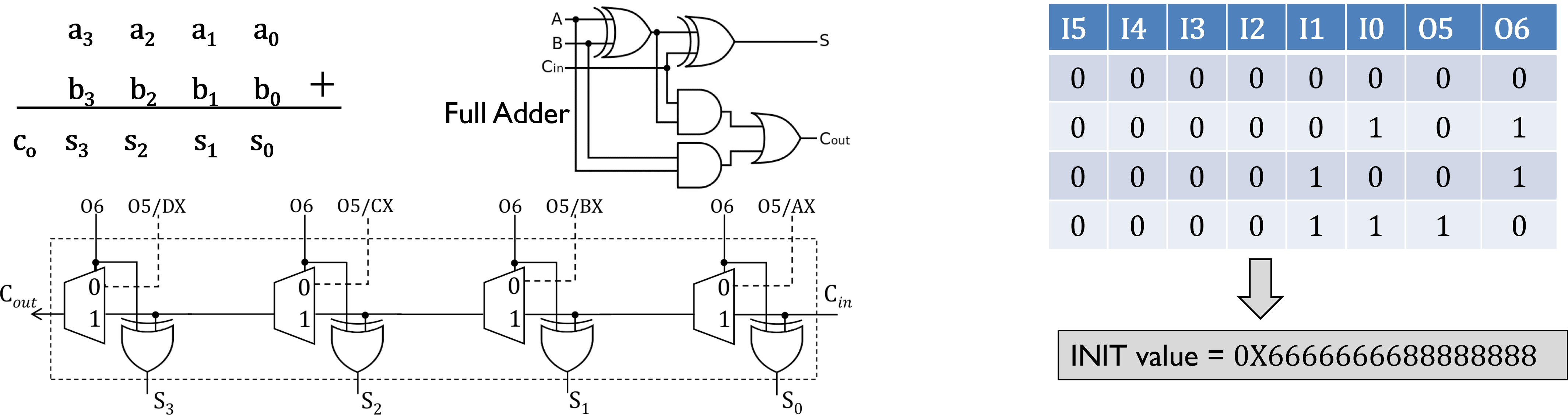
We begin with design: building approximate operators that are natively efficient on FPGAs. Rather than drawing gates and hoping the mapper helps, the tutorial shows how to express logic directly as LUT truth tables (INIT values) and compose them with carry chains so the synthesized circuit matches the intended micro-architecture (Figure 1). This fabric-aware style avoids the common pitfall where ASIC-centric schematics inflate into many LUTs after technology mapping, and it gives us a precise handle to trade accuracy for PPA at the operator level.
Model
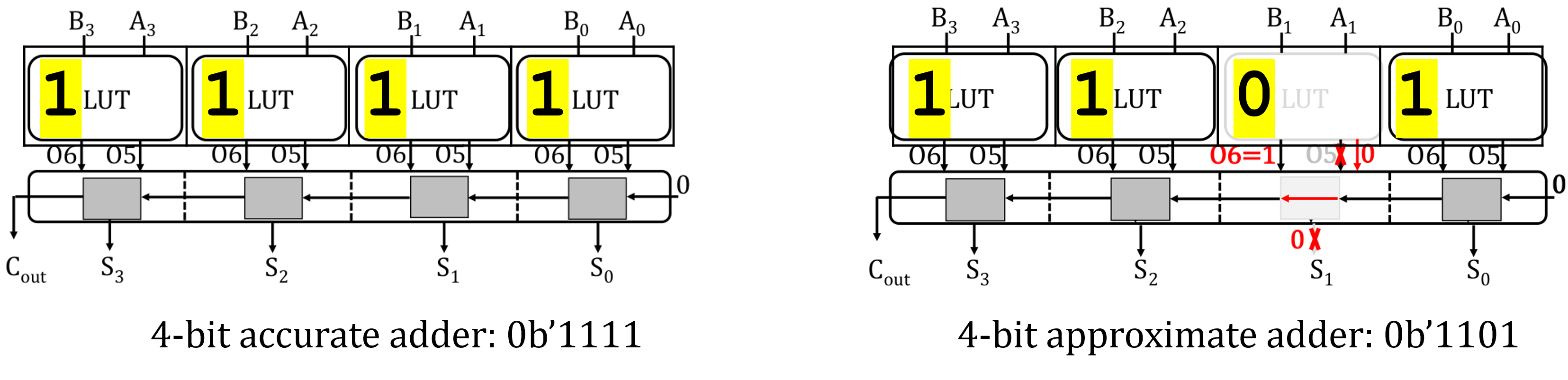
Next we model approximation explicitly: starting from an accurate, LUT-level adder slice, we introduce structured pruning—turning selected LUTs into constants or bypassing carry logic—to trade hardware cost for bounded error (Figure 2). The tutorial shows how to capture these knobs in both behavioral and structural models so we can predict error metrics before committing generating and characterizing RTLs of the approximate operators.
Explore
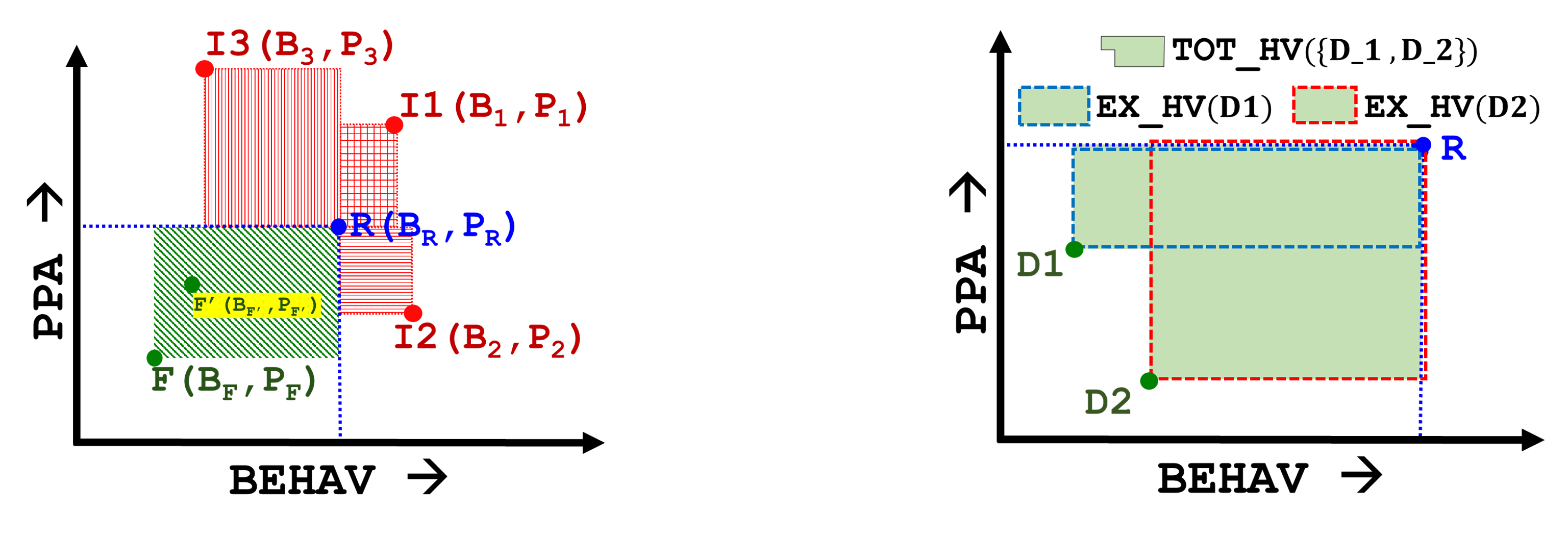
With design knobs in place, we explore the operator space as a multi-objective problem—e.g., minimizing error (BEHAV) while improving PPA. Figure 3 uses two objectives to show how candidates compete: points that are non-dominated form the Pareto front, while dominated ones fall inside the front’s staircase. To quantify overall quality, we measure the hypervolume enclosed by the front and a reference point R; as better designs (e.g., D1→D2) push the front outward, the shaded hypervolume grows. This gives us a single scalar to compare search runs and to decide when the GA/ML-guided search has meaningfully improved the trade-off surface.
By the end of this tutorial, participants will have a solid understanding of how to design, model, and explore approximate arithmetic circuits, equipping them with the skills needed to leverage approximate computing in their own projects.
v1.0 @ ESWeek 2025, Taipei, Taiwan